


A UFO is witnessed by 38 members of an anglican mission firing a beam of light into the sky over the coast of Papua New Guinea on June 27th 1959. Just three months prior, and undoubtedly of no coincidence, the United States Department of Defence classified an exotic potential new weapon top secret.
REVELATION
DragonFire, the UK’s new Laser Directed-Energy Weapon (LDEW), successfully engaged airborne targets during trials in January of this year at the Ministry of Defence’s Hebrides Range in Scotland. By no means are directed-energy weapons a solely modern creation, with the Neutral Particle Beam Accelerator and the YAL-1 airborne laser testbed of the 1980s being recent American examples. Both of which were developed to test a lasers feasibility of destroying ballistic missiles. The range of DragonFire is classified, however; it can engage with any visible target and is under development specifically to counter the rising threat of unmanned aerial vehicles. Prompted by this recent revelation, my thoughts turned to how a famous UFO incident may provide evidence that trials of a similar weapon, successful or not, were conducted far earlier.
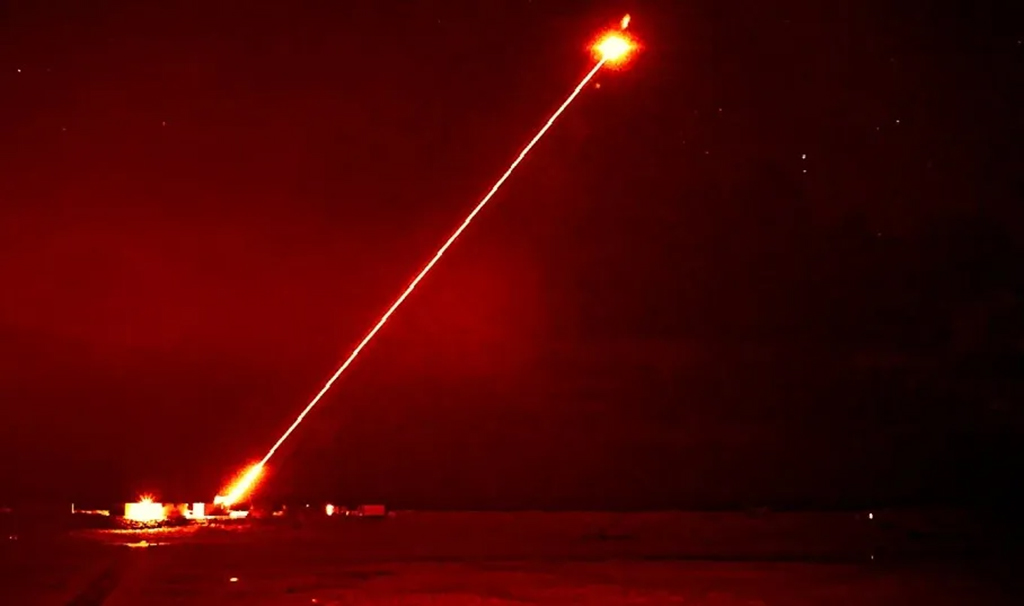
DragonFire trials January 2024. Credit: UK Ministry of Defence
BOIANAI
Between 1958 and 1959, Papua New Guinea found itself in the midst of a UFO wave. A wide variety of glowing lights and disc shaped objects were reported, with the peak of activity occurring in June of 1959. Undoubtedly, the most spectacular sighting took place near an Anglican mission station in the village of Boianai on the north coast of Milne Bay Province, over the consecutive nights of the 26th and 27th of that month. The events were documented by a Priest named Reverend William B. Gill.
26TH JUNE 1959
As stated in Gill’s account, He initially noticed a bright white light in the north western sky. The light approached the mission station then began hovering stationary at approximately 300ft above. Parishioners and staff totalling 38 people (Including Gill) gathered to watch the UFO which was a large disc-shaped object with a wide base and narrower upper deck. The object appeared to have four legs on its underside and four glowing portholes or panels on its side. At a number of intervals, the object produced a shaft of blue light that shone upwards at an approximate angle of 45 degrees into the sky (Gill later described the shaft of light as being pencil thin from his viewpoint). The weather was mainly clear with scattered clouds at first, becoming overcast later on.
What looked like ordinary men appeared out of the object onto the upper deck. There were four men in total, at times only one or two, then three, and four. The shaft of blue light then disappeared along with the men and the object departed as it moved through some clouds. This 25 minute event was followed by other minor UFO sightings during the night, however; the best was saved for the following night.
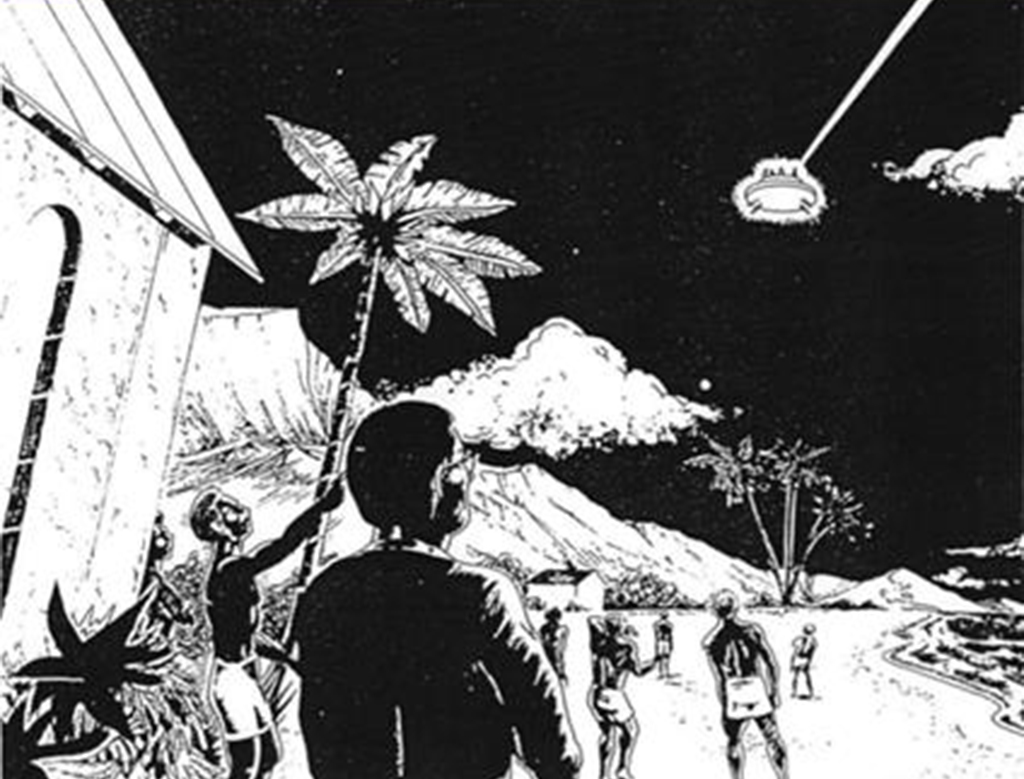
Artists impression of the UFO incident at Boianai. Credit: Unknown
27TH JUNE 1959
From Gill’s account: “Large UFO first sighted by Annie Laurie at 6 p.m. in apparently same position as last night (26/6/59) only seemed a little smaller, when W.B.G. saw it at 6.02 p.m. I called Ananias and several others and we stood in the open to watch it. Although the sun had set it was still quite light for the following fifteen minutes. We watched figures appear on top four of them, no doubt that they are human. Possibly the same object that I took to be the ‘Mother’ ship last night. Two smaller UFOs were seen at the same time, stationary.
One above the hills west, another over- head. On the large one two of the figures seemed to be doing something near the center of the deck, were occasionally bending over and raising their arms as though adjusting or “setting up” something (not visible). One figure seemed to be standing looking down at us (a group of about a dozen). I stretched my arm above my head and waved. To our surprise the figure did the same. Ananias waved both arms over his head then the two outside figures did the same. Ananias and self began waving our arms and all four now seemed to wave back. There seemed to be no doubt that our movements were answered. All mission boys made audible gasps (of either joy or surprise, perhaps both).
As dark was beginning to close in, I sent Eric Kodawara for a torch and directed a series of long dashes towards the UFO. After a minute or two of this, the UFO apparently acknowledged by making several wavering motions back and forth. Waving by us was repeated and this followed by more flashes of torch, then the UFO began slowly to become bigger, apparently coming in our direction. It ceased after perhaps half a minute and came no further. After a further two or three minutes the figures apparently lost interest in us for they disappeared “below” deck. At 6.25 p.m. two figures re-appeared to carry on with whatever they were doing before the interruption. The blue spotlight came on for a few seconds twice in succession.”
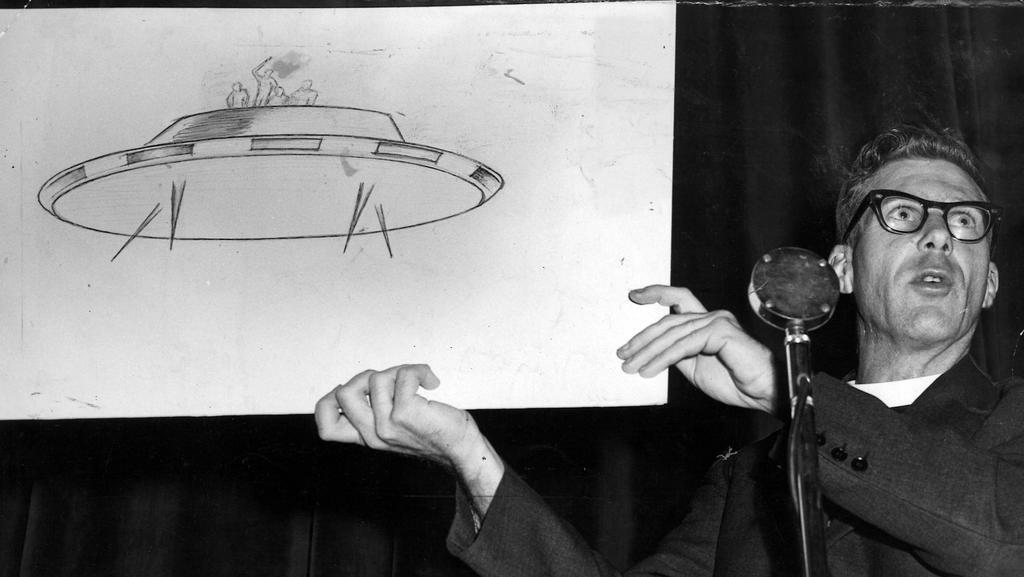
Rev. William Gill at a meeting of the Victorian Flying Saucer Society October 1959. Credit: Unknown
Gill later described how he and some of the other witnesses called out to the men, and beckoned them to descend, however there was no response to this request. As the scene had remained largely unchanged by 6.30 p.m., Gill went to dinner. Critics would later question this action, stating why would someone walk away from such an extraordinary sight? Gill responded: “Having had about four hours of this sight on Friday night, we were not nearly so interested when it returned on Saturday night, especially after we were unable to persuade it to land. You must also keep in mind that there was nothing eerie or other worldly about any of this. It was all so ordinary, as ordinary as a Ford car. It looked a perfectly normal sort of object, an earth made object. I realized, of course, that some people might think of this as a flying saucer but I took it to be some kind of hovercraft the Americans or even the Australians had built. The figures inside looked perfectly human. In fact, I thought they were human, that if we got them to land we would find the pilots to be ordinary earth men in military uniforms and we would have dinner with them.”
Following dinner, the large UFO was still present at 7pm, although further away. The group of observers soon went to church for evensong. After this, the sky appeared overcast and with the low visibility nothing else was seen that evening. The following night some minor UFO activity occurred, however nothing as compelling as the previous night. The Boianai UFOnauts, along with their aircraft, had departed and were never seen again.
A NEW THREAT
The 21st of August 1957 saw the successful test launch of the Soviet Union’s R-7 Semyorka, the worlds first Intercontinental Ballistic Missile (ICBM). Designed to deliver a nuclear warhead to American soil, the missile flew an incredible 3,700 miles and marked a perilous turning point in the Cold War. Now faced with a potential nuclear missile attack, America raced to find a defensive solution to this new threat and to complete its own ICBM program. The latter resulted in the successful test flights of the Atlas D ICBM during November of 1958, and the Titan I ICBM during February of 1959. An Anti-Ballistic Missile System, or ABM, named Nike Zeus, emerged as the former.
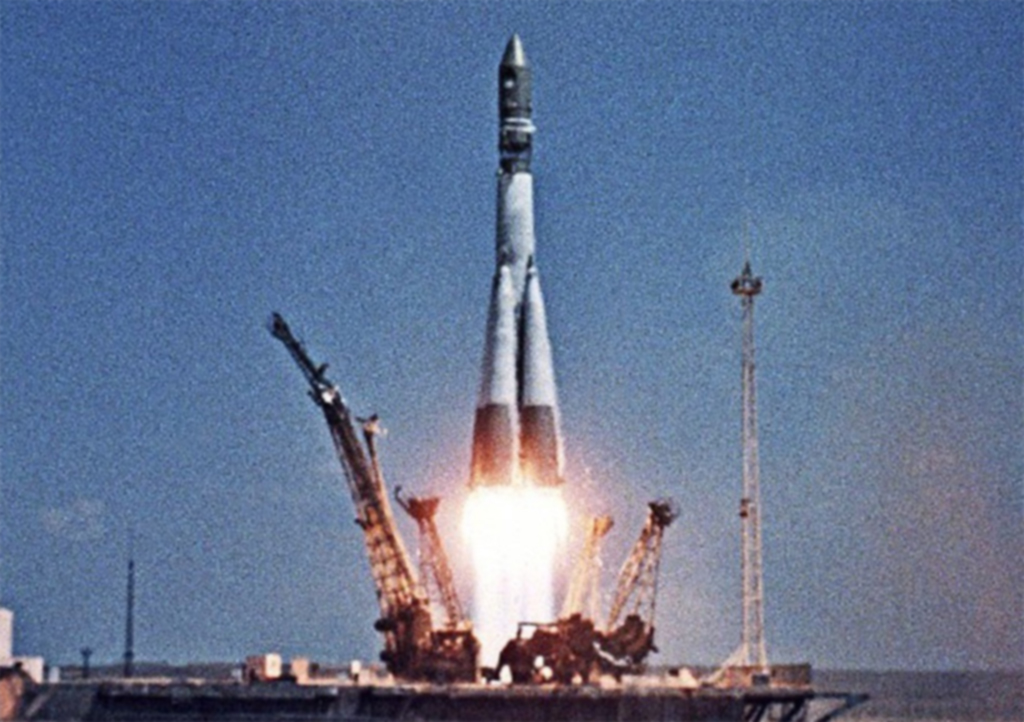
R-7 Semyorka ICBM launch. Credit: Unknown
The vast American Pacific Missile Range (PMR) along with the Pacific Proving Grounds (PPG) were selected as the sites for the operational trials of both programs. From early 1959, the United States Department of Defence approved the launching of target Jupiter ballistic missiles to simulate inbound Soviet ICBMS, from Johnston Island, an Atoll also under the control of the U.S. military.
These were to be intercepted by Nike Zeus missiles launched from Kwajalein Atoll as part of testing for the Nike Zeus system. The target vehicles were programmed to impact close to the Enewetak and Kwajalein Atolls of the PPG.This arrangement was later modified so that Atlas ICBMs launched from Vandenberg Air Force Base in California would be used as the new target vehicles. All the target vehicles were programmed to impact close to the Enewetak and Kwajalein atolls of the PPG.
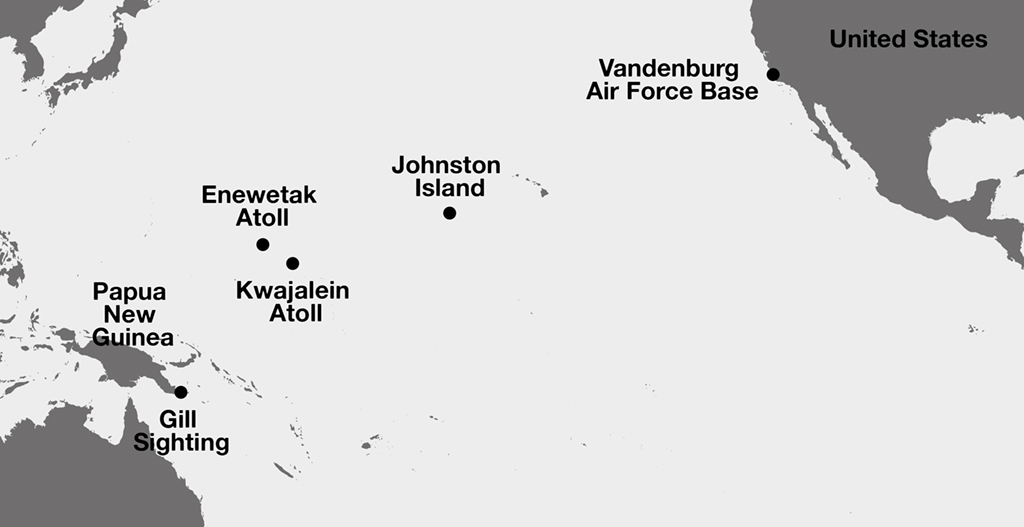
Pacific Missile Range and key locations.
Feeling threatened that Nike Zeus would soon replace a strategic bomber offensive as the nations main deterrent in the face of a Soviet attack, the USAF introduced the cost-exchange ratio in 1958. This was a formula that compared the cost of a single enemy ICBM against the cost of the multiple Nike Zeus systems that would be needed to intercept it. The formula illustrated that the enemy would have a crushing advantage overall. To further strengthen their argument, the USAF illustrated that a single Soviet ICBM can have multiple re-entry vehicles, which would completely overwhelm any Nike Zeus system.
In response to this dilemma, the DoD turned to the recently created Advanced Research Projects Agency (ARPA) and immediately tasked them with finding new defensive solutions to the Soviet ICBM threat. The agency had been assembled in February of that same year for the purpose of creating research and development projects that would hopefully advance the frontiers of technology and science for use in military applications. In truth, the agency had been created in reaction to the launch of Sputnik the previous year which was the first artificial satellite to orbit the Earth. This Soviet achievement made it clear to the U.S. that they were lagging far behind in the field of military technology. ARPA responded to the DoD’s request by initiating Project Defender, a program that studied how to destroy the nuclear warheads on ICBMs. The program particularly focused on advanced new technologies and far-out concepts.
A POTENTIAL SOLUTION
Theodore Maiman along with his employer, Hughes Aircraft Company, announced their new invention to the world on the 7th July 1960. Since that day, he has been widely credited as the inventor of the laser. However, perhaps lesser-known was the intense competition to the develop such a device in the lead up to Maiman’s announcement. Throughout the late 1950s a number of research laboratories were also developing their own laser designs, such as Bell Laboratories, International Business Machines, Westinghouse Research Laboratories and the Technical Research Group Corporation (TRG).
In August of 1958 Bell Laboratories were the first to file a patent for a laser design, leading TRG to approach ARPA in December of 1958 in the hopes of securing additional funding to expedite their own laser project. Excited by the proposal, ARPA responded by providing far more funding than was requested – a rare step taken by ARPA. By April of 1959 ARPA and the DoD had classified the TRG laser project secret. Whatever TRG were doing, the DoD deemed it important enough to hide it from public view.
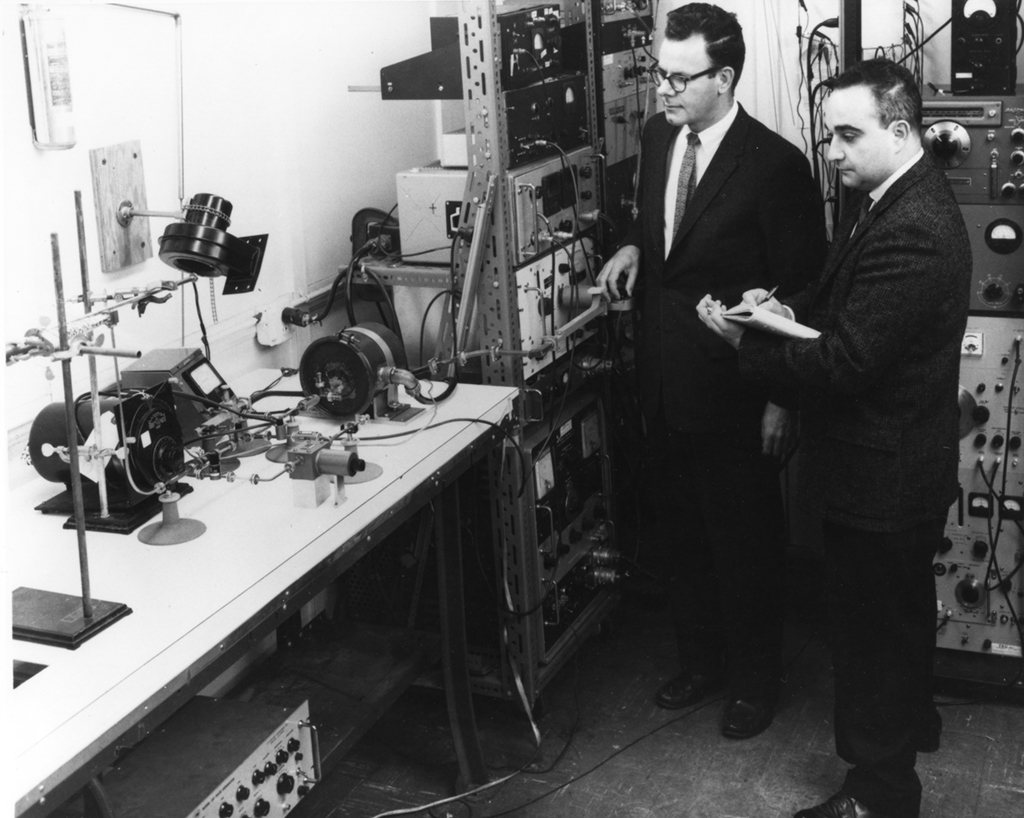
Laser physicist Gordon Gould (left) at TRG. Credit: AIP Emilio Segrè Visual Archives
Is it possible that TRG’s laser had secured a place within ARPA’s Project Defender? This we may never know, however; it is important to remember that the sole reason for ARPA’s existence was the advancement of military technologies, and in early 1959 their primary and possibly only focus was neutralising Soviet ICBMs.
It’s interesting to note that during their meeting to secure funding with ARPA, TRG stated that their laser would be able to knock attacking missiles out of the sky. Just four months before ARPA’s laser was classified, the Soviet Union had claimed that their ICBMs were in mass production and were capable of a staggering 8000 mile range. This, coupled with a failed launch of a U.S. Titan ICBM that same month (along with the issues already exposed within the Nike Zeus program), reinforced the need for defensive solutions to be found, and quickly.
BOIANAI AGAIN
If indeed LDEW trials took place on the nights of 26th and 27th June 1959 near Boianai, then attention must be given to that specific location. Data suggests that the events witnessed by Gill were just one part of a larger set of ARPA trials designed to assess the effectiveness of such a device against target re-entry vehicles.
Upon receiving Gill’s UFO report, Revd. Norman Cruttwell (his colleague) created his own report on the Papuan UFO wave in general. He concluded that the sightings were concentrated in specific areas, and stated: “Of these 79 sightings the majority (60?) have been seen over the Cape Vogel Peninsula, Goodenough Bay and the mountains immediately adjacent to them. This area would not be more than 100 miles in length (W to E) and about 50 in depth (N to S). Within these principal sighting points have been Boianai, Baniara, Giwa, Manapi, and Ruaba Plain. There was a second minor concentration around Samarai and Sideia, about 100 miles further East. At Boianai the objects seemed particularly to hover near, or proceed from, the vicinity of Mount Pudi (4000ft.).”

Map detailing locations of UFO sightings from Cruttwell’s 1960 report. Credit: Norman Cruttwell
It’s unknown how many sightings were of the same object(s), however; this seemingly unrandom concentration over Milne Bay Province suggests that an operating procedure was being followed. Could this specific location have been designated as a staging point before LDEW trials were set to begin? The United States Government was already intimately familiar with the extremely remote Australian administered territory, having installed extensive military infrastructure there during the Second World War, such as bases and airfields. Many of which were still active during 1959.
Interestingly, the distance between Milne Bay Province and Johnston Island, the planned launch site of Jupiter target vehicles for the Nike Zeus trials, is approximately the same distance of the range achieved by the first R-7 Semyorka ICBM. One reason that this may have been intentional could have been to replicate a specific distance from the continental United States to a point of interception for Soviet ICBMs.
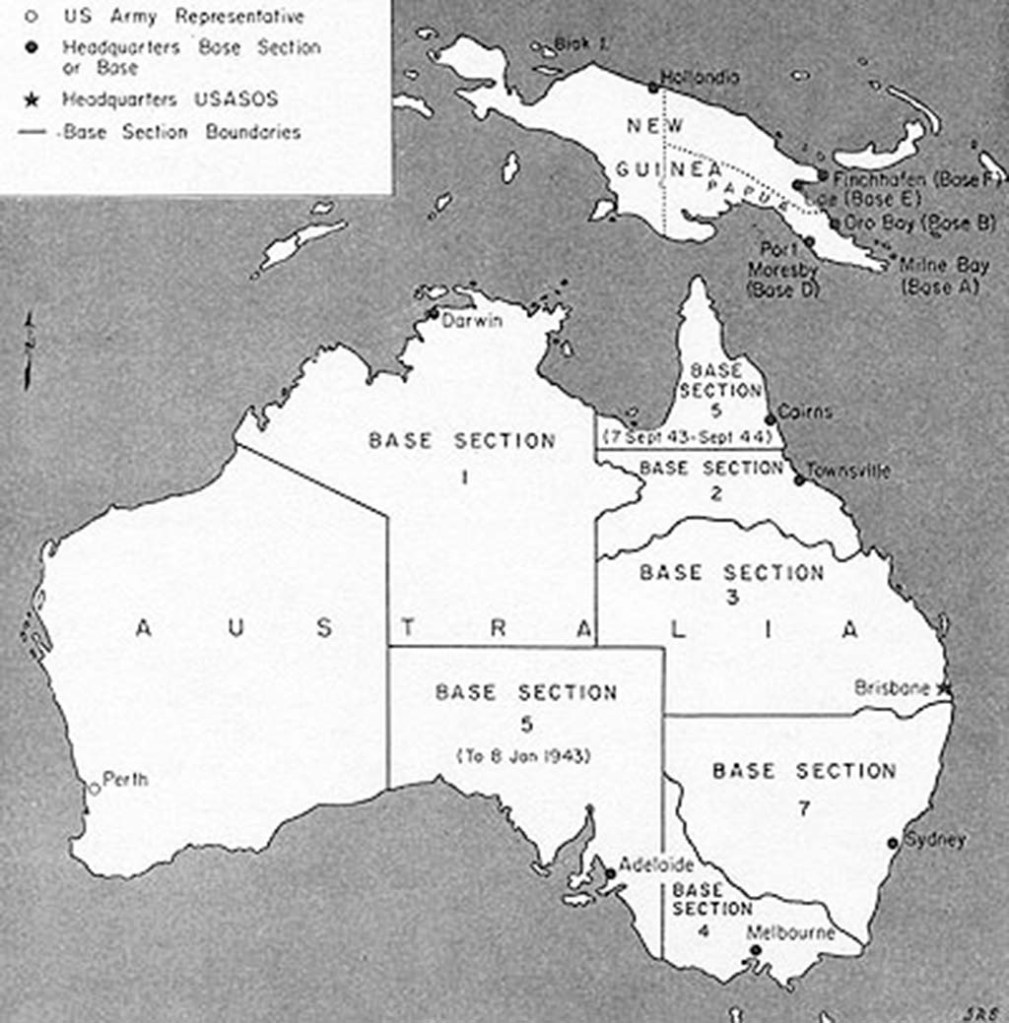
Major American bases on Papua New Guinea 1942. Credit: Unknown
Many of the Jupiter Launches from Johnston Island remain classified to this day as do many Redstone and Thor missile launches, and it wouldn’t be unusual for any to have been omitted from official records on the grounds of national security.
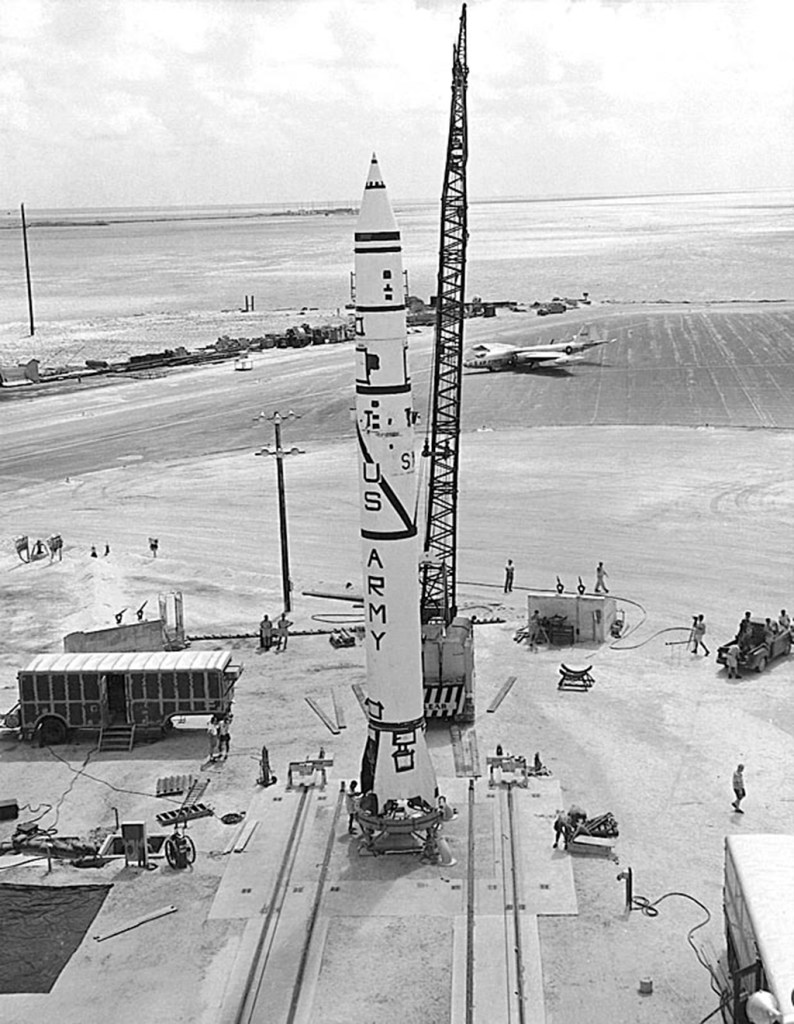
Redstone ICBM at Johnston Island August 1958. Credit: Unknown
A mobile LDEW system would alleviate the need for fixed position ABM sites along with the defence implications associated with them, should their positions be compromised. It would also help drastically reduce the range to target and increase effectiveness, should such a weapon be more powerful at closer ranges.
INTERACTIONS
The 13th of May 1942 saw the delivery of the first Sikorsky R-4 to the United States Army Air Forces (USAAF) at Wright Field in Dayton, Ohio. The R-4 was the first mass-produced helicopter and the first helicopter to enter service with the USAAF. The delivery saw the aircraft travel 761 miles through 16 separate flights over five days from its starting point at Bridgeport Airport in Stratford, Connecticut. The journey also broke many world records in the process, such as the first helicopter delivery flight.
Some interesting interactions during the journey were recalled by Charles L. Morris, the chief test pilot for the Sikorsky Aircraft Corporation and who was piloting the R-4 on that day. Morris stated: “this trip was marked by constant astonishment, as people saw things happening in front of their eyes that they had never dreamed of before.” While travelling through the Mohawk Valley in New York State at an altitude of 300 feet, Morris vividly remembers numerous people rushing out of their houses below, all the while gaping skyward at the strange looking device in the sky. Before landing at Utica (also in New York State), Morris stated: “I drifted up sideways in front of the hangar and hung there stationary for a minute or so while mouths dropped open wide enough to land in. Then I slid over to the ramp and squatted down. The guard greeted me as I walked up to the office: “I don’t believe what I saw just now! Of course, I realize this is a secret ship, but do you mind if I look again when you take off?”
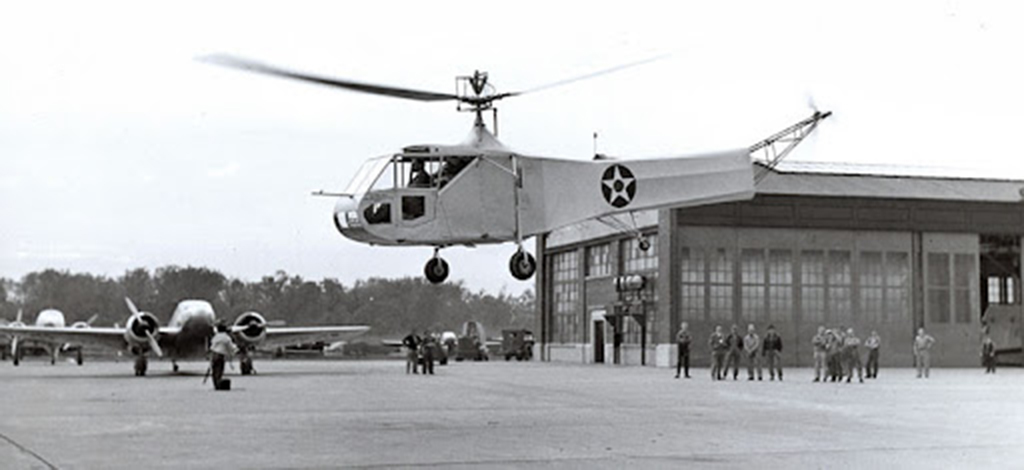
Sikorsky R-4 at Wright Field, Ohio 1942. Credit: Sikorsky Historical Archives
Most interesting of all (for the purpose of this article) was the penultimate stop at Springfield Airport in Ohio. Morris stated: “Before landing, I hovered a while, facing the incredulous group that emerged from the administration building. Then one young fellow signalled me very tentatively to move over slightly to the left. I obliged. With more confidence, he signalled me to the right, and once more I obeyed. With recklessness born of success, he signalled for me to go straight up in the air-and when I actually did so, he threw up his hands and quit! “That’s the biggest damn lie I ever saw!” he said.” In other words, the young man simply couldn’t believe his eyes.
This playful interaction is remarkably similar to the communication experienced between the witnesses and the UFO seen over Boianai on the evening of 27th June 1959.
Findings have demonstrated that the cathartic nature of play provides a psychological relief from the frustrations and stress that we experience through long periods of work, and as such it’s within human nature to desire or engage in it, especially after performing laborious or dull tasks. This may indeed have been the case with regard to the UFOnauts of Boianai, who had already spent many hours on their seemingly important task. Might they have found amusement by deliberately manoeuvring their classified aircraft in response to the torchlight commands from below? Or like Charles L. Morris, was this simply showing off in an attempt to further astonish their bewildered spectators?

Artists impression of the UFO incident at Boianai. Credit: Unknown
Of no doubt were those spectators, largely Milne Bay natives, on who organised the previous nights spectacle when they greeted Ernie Evennett the following day. The trader, who also saw the UFO from across the bay, was asked: “Sir, did you see the American Air Force last night? We did at Boianai.”
Bye then.
 UFONAR
Definitely showing off! Excellent article- I thoroughly enjoyed reading it